When the harasser is a customer
Since 30 October 2026, employers in England, Scotland and Wales must take all reasonable steps to prevent their workers being harassed by customers, clients, patients and other third parties.
Free download
Respect notices for your workplace
Seven A4 notices for the places your people deal with customers, clients, patients and visitors. Each one sets a clear standard, in wording written for its setting: hospitality, retail, health and care, schools, events, public counters, and a version for any workplace.
- Print-ready PDF for each notice
- Editable PowerPoint version, so you can adjust the wording
- Displaying a conduct notice is one of the controls in our Third-party harassment toolkit
Seven settings: any workplace, hospitality, retail, health and care, schools and education, events and leisure, and reception and public counters.
Get your free respect notices
Enter your details and your downloads will open straight away. We’ll also send you occasional emails from iAcademy about the duty to prevent harassment. You can unsubscribe at any time.
Your respect notices
Download the PDF to print as it is, or the PowerPoint version to add your logo.
- Respect works both ways.Any workplace
- Respect is always on the menu.Hospitality
- Kindness costs nothing.Retail
- Care for the people who care for you.Health and care
- The smartest thing we teach is respect.Schools and education
- Good times. Good manners.Events and leisure
- Patience. Courtesy. Respect.Reception and public counters
Want the full set of controls behind these notices? See the Third-party harassment toolkit.

Tools for third-party harassment
Start with our free guides: a director's guide to the duty, a Board self-assessment, a guide to the toolkit and a trauma-informed investigation guide written with Rely. Get the free guides →
The Third-party pack gives managers and HR teams six practical tools to prevent harassment by customers, clients and members of the public, act quickly and fairly when it happens, and keep a clear record of the steps taken.
Third-party harassment toolkit. Find where your people are most exposed to harassment by customers, clients and the public, and put prevention and response steps in place for each setting, including conduct notices for customers.
Third-party incident decision guide. Takes managers step by step through the decision when a customer, client or other third party crosses the line, from a warning to removing or banning them, or calling the police.
Client relationship protocol. What to do when a client the organisation values harasses one of your people, so the decision rests on protecting your people rather than keeping the account.
Authority matrix. One page that shows who can end an interaction, refuse service, ban a person or end a contract, so managers know they can act on the spot.
Contract clause library. Conduct terms for client engagements, secondments, agencies, suppliers, venues and customers, so expectations are set before work starts.
Incident and ban records guide. How to record incidents and share information about customers and clients lawfully under UK data protection law.
Third-party pack, £145. Also included in the full series of sixteen tools, £395. To assess risk across your whole workforce, add the Risk assessment toolkit in the Prevention pack.
What changes
A third party is anyone who isn't one of your workers: customers, clients, patients, students, service users, contractors' staff and members of the public.
Until now, the duty has centred on how colleagues treat each other. The Employment Rights Act 2025 extends it to people the employer doesn’t employ. Prevention now has to reach the customer at the bar, the client in a meeting and the patient on the ward.
The duty covers harassment related to any protected characteristic, as well as sexual harassment. Parliament considered an exception for conversations a worker happens to overhear and rejected it. Read our guide: Are employers liable for third-party harassment?
Who the law protects, and who good practice protects
The legal duty protects your employees and workers. It doesn't extend to volunteers, which the Supreme Court confirmed in 2012.
Good practice goes further. Prevention works best when it covers everyone who takes part in your workplace: employees and workers, volunteers, interns, contractors and agency staff, and Board members. People notice who a policy protects, and a gap for some groups tells everyone how seriously the organisation takes it.
Who it affects most
Third-party harassment can happen in any workplace, and it's far more common in some sectors. Hospitality, retail, health and care, education, transport, events and sport carry the most risk, because their workers spend most of their working time with customers, often late, often alone and often where alcohol is involved.
Customers, clients and patients are a major source of harassment, and the people on the receiving end rarely report it.
Complaint numbers will understate what is happening, and the gap is widest where the harasser is a customer and no one thinks a report will change anything.
Third-party harassment in numbers
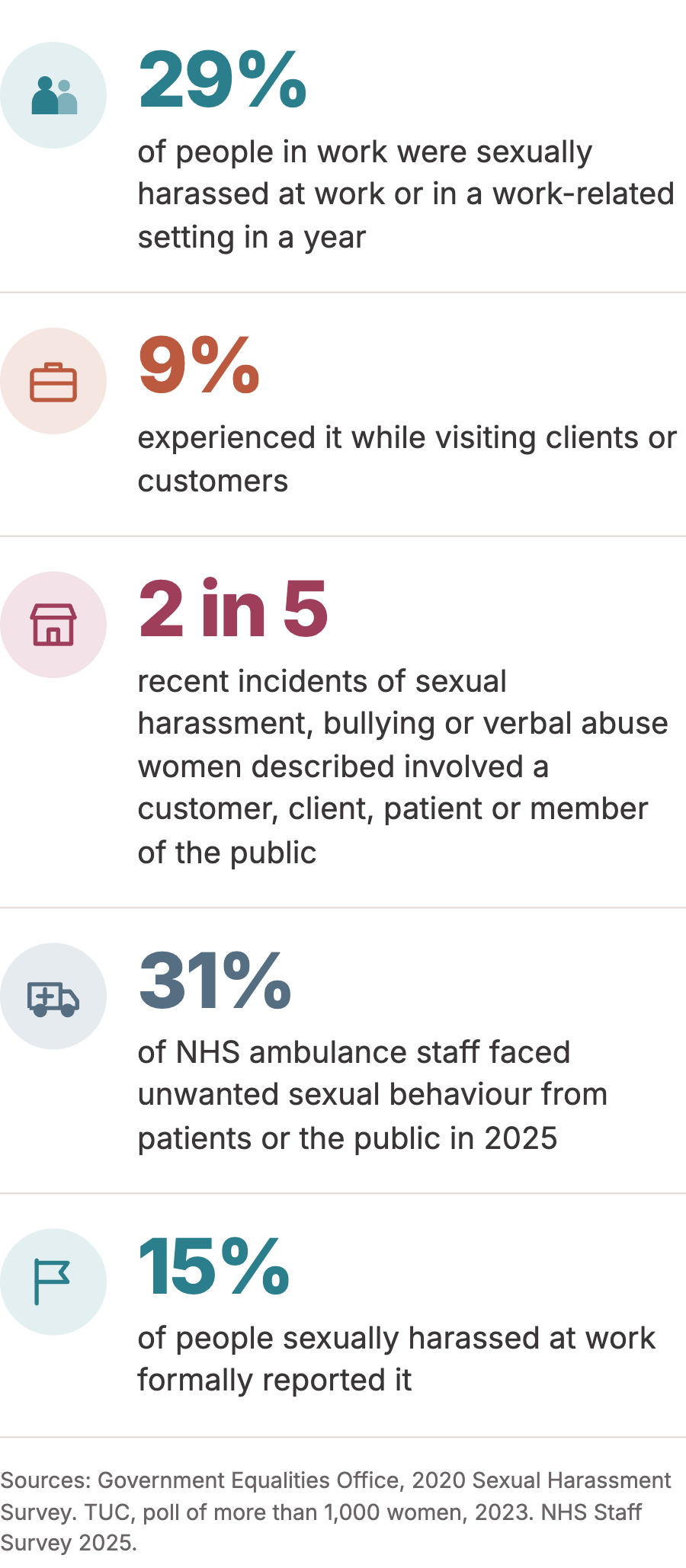
In the Government Equalities Office's 2020 Sexual Harassment Survey, 29 per cent of people in work had been sexually harassed at work or in a work-related setting in the previous year, and 9 per cent while visiting clients or customers. Only 15 per cent of people sexually harassed at work formally reported it.
In a 2023 TUC poll of more than 1,000 women, two in five recent incidents of sexual harassment, bullying or verbal abuse that women described involved a customer, client, patient or member of the public.
In the 2025 NHS Staff Survey, 31 per cent of NHS ambulance staff faced unwanted sexual behaviour from patients or the public.
What all reasonable steps looks like here
The steps differ from those for harassment between colleagues, because the employer cannot discipline a customer. In practice they include:
a risk assessment that names the settings, times and customer groups where harassment is most likely
a clear statement to customers of the behaviour you expect, and what happens if they cross the line
a decision guide for duty managers on removing, refusing or banning a customer, and when to involve police
reporting pathways workers will use in the moment, and a regular look at what those reports tell you
support for the worker after an incident, including how they get home safely
terms with contractors, agencies and venue partners that set out who does what
Learning from the Australian experience
Australian employers that met their duty well gave frontline managers the authority to act on the spot, and used what their people reported to change rosters, layouts and house rules.
Courses
Preventing workplace sexual harassment for team members shows staff what to do when a customer harasses them or a colleague. Preventing workplace sexual harassment for people leaders gives managers the decision-making skills for third-party incidents.
General information. It is not legal advice. Sources: Government Equalities Office, 2020 Sexual Harassment Survey (2021). TUC, poll of more than 1,000 women (2023). NHS Staff Survey 2025 (2026). X v Mid Sussex Citizens Advice Bureau [2012] UKSC 59.