
What your Board should ask for
The duty to prevent sexual harassment belongs to the employer, and the Board decides how the employer oversees it. Directors need to know where the risks are, what to ask about them, and whether prevention is working. The five steps below give your Board each of those, in the order you’ll need them.
What happens after someone is harassed
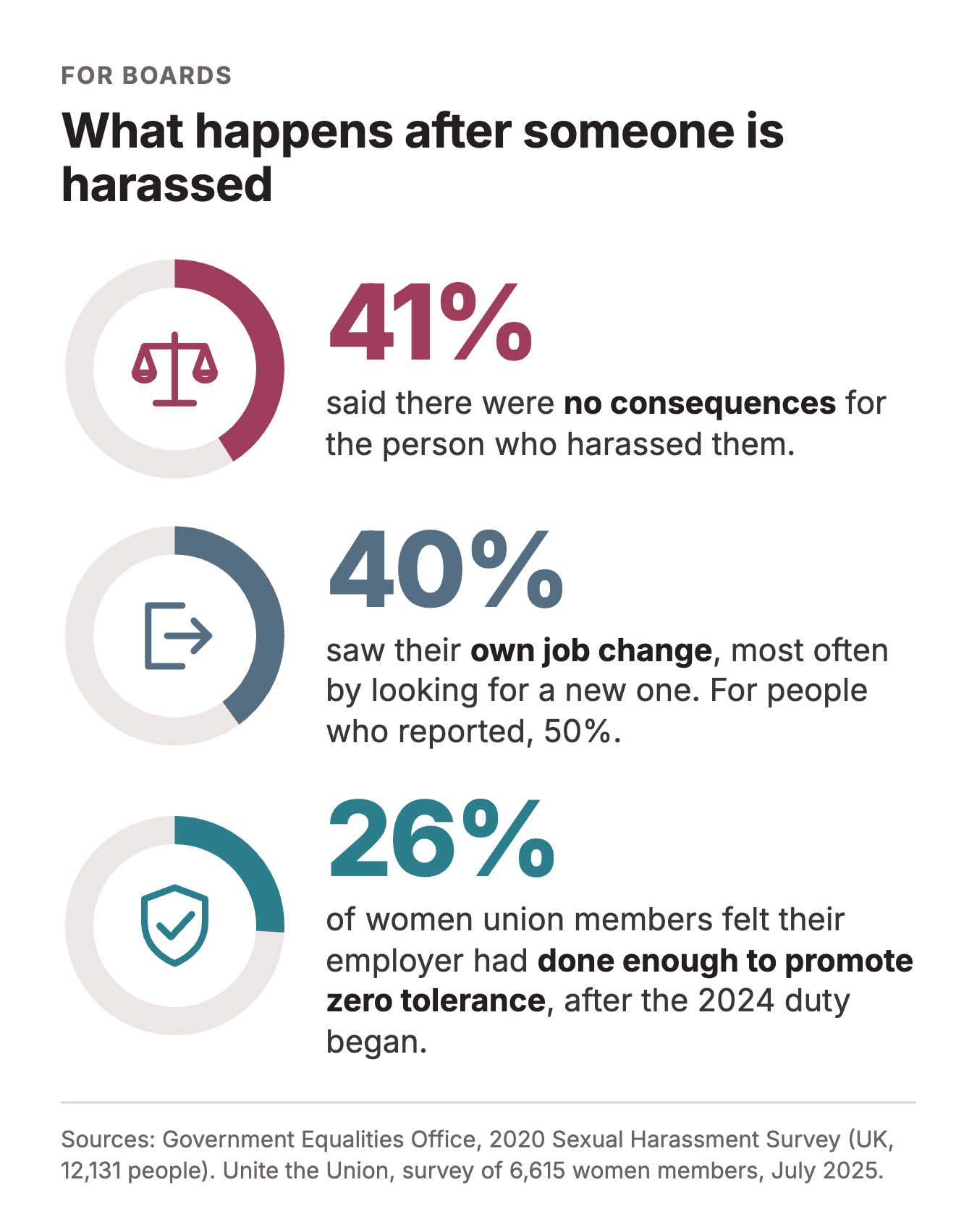
In the Government Equalities Office's 2020 Sexual Harassment Survey of 12,131 people in the UK, 41 per cent of people sexually harassed at work said there were no consequences for the person who harassed them.
And 40 per cent saw their own job change, most often by looking for a new one. Among those who reported the harassment, it was 50 per cent.
In Unite the Union's survey of 6,615 women members in July 2025, only 26 per cent felt their employer had done enough to promote zero tolerance after the 2024 duty began.
What questions should a UK Board ask about sexual harassment?
By Maria Twomey, Principal, Intersection. Last reviewed 27 October 2026.
Since 30 October 2026, employers in England, Scotland and Wales must take all reasonable steps to prevent sexual harassment of their workers, including by customers, clients and other third parties. The Board’s role is oversight. Directors need to know where the risks are, whether the controls are working, and whether people trust the organisation enough to report. Start with these three questions for management.
Where in our organisation is sexual harassment most likely, and how do we know?
What have we done about each of those places, and what has changed as a result?
Who are our customers, clients and other third parties, and what is our plan for harassment by them?
Read all ten questions, and what a good answer looks like →
Five steps for your Board
Know what the duty asks of you. Read our free director guide before your next Board meeting.
Test where you stand. Take the Board self-assessment online, as a Board or in your risk committee.
Train every director. All reasonable steps: Governing for the duty to prevent, an eLearning course in our Governance Series.
Go deeper together. Join the Governing for Workplace Culture virtual classroom, an expert-led series for small cohorts of directors, executives and risk professionals.
Keep the information coming. The Board reporting pack gives your Board a quarterly view of the duty, with leading and lagging indicators.
What Australian Boards learned
Australian Boards have operated under a positive duty since December 2022. The Boards that did it well made prevention a standing item on the risk agenda, asked early where harassment was most likely, and asked why when the complaints register went quiet. The UK duty is different law, but the Board’s questions are the same.
Brief your Board with us
We brief Boards and Executive Teams directly, in person in London or by video. Hear about the duty, and what it asks of directors, from people who worked on Australia’s national inquiry.