
Courses for every level of your organisation
Three eLearning courses written for the strengthened duty in England, Scotland and Wales, including harassment by customers and clients. Each is audience specific, so Boards and Executive Teams, People Leaders and Team Members learn what their role requires.
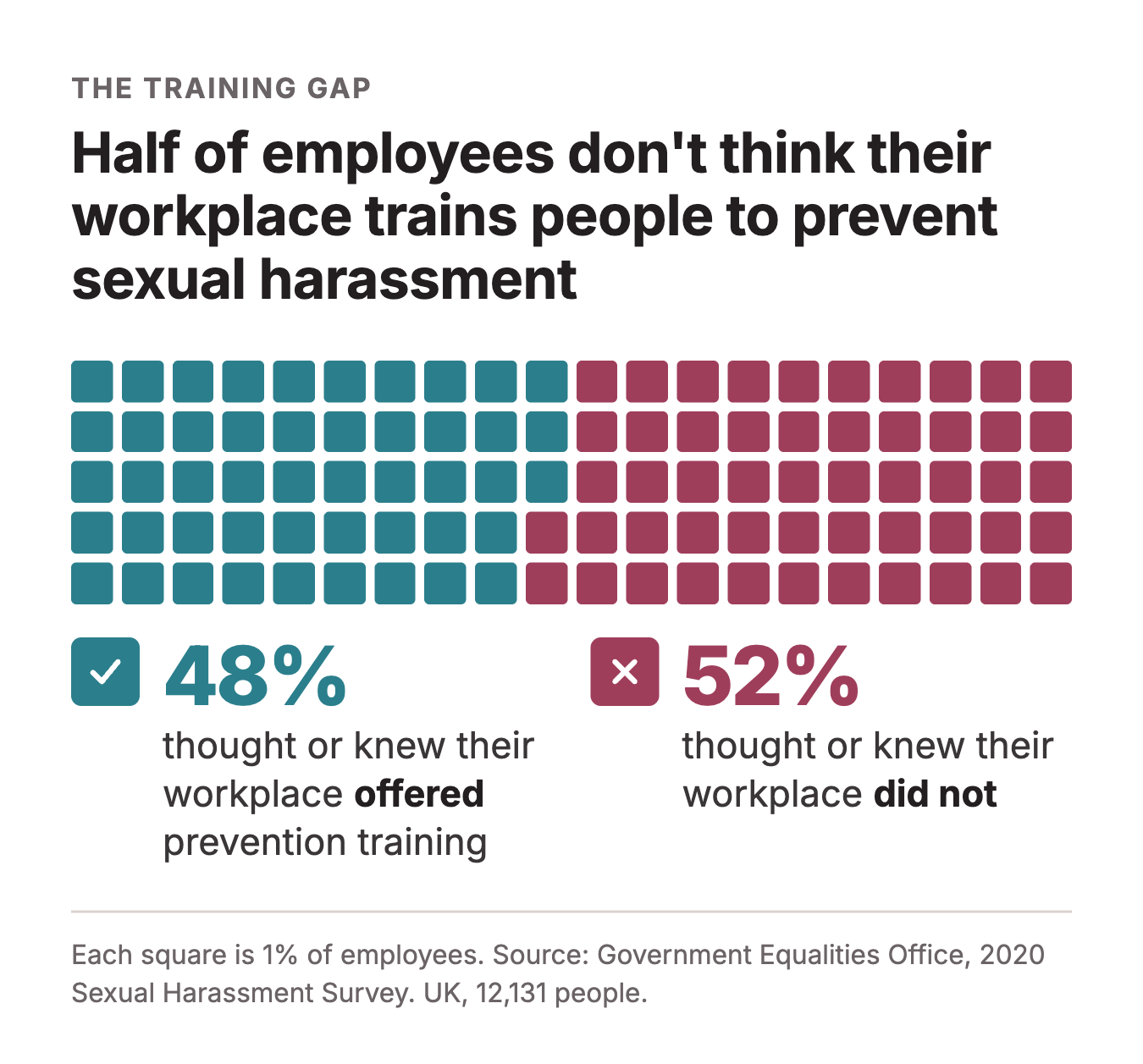
The training gap
In the Government Equalities Office's 2020 Sexual Harassment Survey of 12,131 people in the UK, 48 per cent of employees thought or knew their workplace offered sexual harassment prevention training.
The other 52 per cent thought or knew it did not.
All reasonable steps: Preventing workplace sexual harassment for team members
eLearning · Team Members
Know what sexual harassment looks like, how to help prevent it, and what to do when you experience or witness it, including harassment by customers and clients.
You’ll learn:
what sexual harassment is under the Equality Act 2010, with workplace examples
what to do when a customer or client harasses you or a colleague
how to report, what happens next, and your protection from victimisation
how to act as an active bystander using the 5 Ds: distract, delegate, document, delay, direct
Certificate on completion. From £12 per person a year.
All reasonable steps: Preventing workplace sexual harassment for people leaders
eLearning · People Leaders
Prevent sexual harassment in your team, and respond to anyone who comes forward in a person-centred, trauma-informed way.
You’ll learn:
the employer’s duty and your part in meeting it
how to respond to a disclosure, including when the person doesn’t want to make a formal complaint
how to decide what to do when a customer or client harasses a team member
how to follow up so it doesn’t happen again
Certificate on completion. From £30 per person a year.
All reasonable steps: Governing for the duty to prevent
eLearning · Boards and Executive Teams · Governance Series
Understand what the strengthened duty asks of directors, and how to oversee the steps your organisation takes.
You’ll learn:
what all reasonable steps means for the Board, and how it fits with directors’ duties
the information your Board should receive, and the questions to ask when it doesn’t
what sector regulators now expect of Boards, including the FCA in financial services
what Australian Boards learned from operating under a positive duty since 2022
Certificate on completion. £95 per director, or £850 for a Board licence.
Annual subscription. Our courses are sold as an annual subscription. We'll email you 30 days before each renewal with the date and the price for the next year, and you can cancel at any time by emailing us.
Governing for Workplace Culture: Virtual Classroom
This expert-led virtual classroom series brings together small cohorts of senior leaders, including executives, risk professionals and Board directors, to work through the duty and what Boards should expect to see. Sessions run in UK time.
Training your whole organisation
For larger groups, or to run our courses in your own learning system, talk to us. Our courses can be customised to your industry and organisation with relevant case studies and statistics. We’ve customised training for hospitality, retail, sport, construction, media, healthcare, mining and the arts.
Each course issues a certificate of completion you can use as evidence of continuing professional development with your professional body.
What changes after our training
We ask participants to rate themselves before and after each course. In our most recent evaluation, more than 750 leaders took part across 35 sessions. The table shows the share who rated themselves strongly on each statement.
| Participants who said… | Before training | After training |
|---|---|---|
| I know what counts as bullying, discrimination, harassment and sexual harassment | 57% | 94% |
| I understand my obligations as a leader to prevent it | 61% | 95% |
| I know what to do if someone tells me about it or reports it | 47% | 82% |
| I am confident to respond when a colleague behaves inappropriately | 36% | 85% |
We use what participants tell us to improve our courses, and we share the results with each organisation we work with.